



3 2 1 a cross style brewing showcase
Brewing Showcase | How does the same hop perform across different beer styles?
JOIN US OUR BREWING SHOWCASE VIRTUAL TASTING SESSION
MISSED OUR BEERX BREWING SHOWCASE? DON'T WORRY WE HAVE YOU COVERED!
In response to a question brewers often ask, “How does the same Hop Development Variety perform across different beer styles?”, this immersive tasting session brings together three brewers, each presenting two beers brewed with a single hop variety. Guided by the Charles Faram panellists, the 3,2,1 format explores how one hop can express itself in dramatically different ways depending on style, process, and creative intent.
Featuring star guests, Mike Mason – Mason Brewing Co, Dan Lawson – Copper Beech Brew Co and Pip Wagg – Ampersand Brew Co.
FIVE MINUTES WITH FARAM
KEITH BOTT FROM TITANIC BREWERY
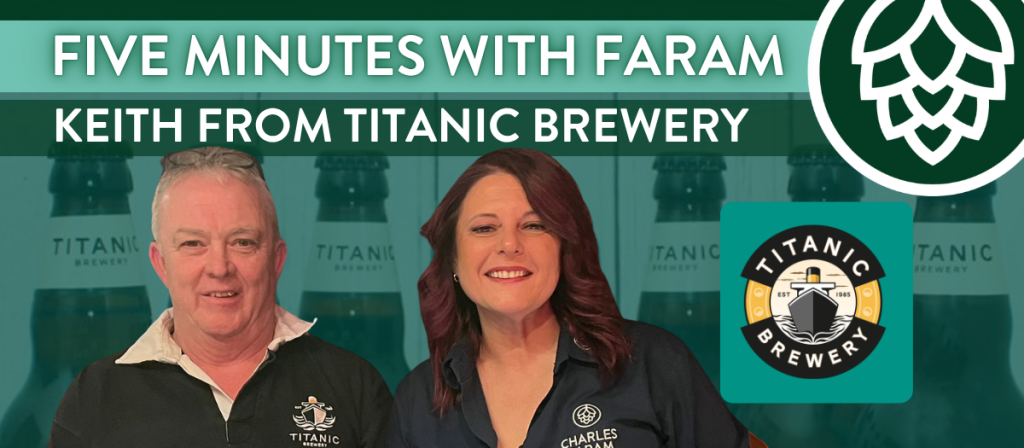
Five Minutes With Faram – Titanic Brewery (Keith Bott)
Charlie: Hi everyone, welcome to this month’s Five Minutes with Faram. I’m here with Keith Bott, owner of Titanic Brewery. Keith and I have known each other for years in various roles, including when you were my boss at Titanic and later at SIBA. Let’s jump straight in. What is your current favourite hop, and why?
Keith: It’s tough because there are so many great hops, but Cascade is still my favourite. It has such a great flavour and works brilliantly whether used early or late in the boil. It gives beer a smoothness like nothing else.
What beer style are you loving right now?
Keith: Plum Porter still amazes me. If you’d told me when we first brewed it that it would become our best-selling beer, I’d have said you knew nothing about brewing. Yet here we are, this 4.9% fruit beer is over half of what we brew. And now we’ve released a nitro version, which the brewers say is even better than the cask.
What has been a beer epiphany moment for you?
Keith: Visiting Pilsner Urquell in the Czech Republic. Sitting in the cellars with friends, drinking unfiltered, unpasteurised Pilsner Urquell, it was one of those moments where you realise how fabulous beer can be.
What’s your favourite beer destination?
Keith: Honestly, my local pub. I live next door, so I can wander over for a pint. It’s perfect.
What small technique or tweak has made a big difference to your beer?
Keith: When we started brewing in the 80s, nobody added hops late in the boil. Discovering late hopping opened a whole new world for us. It changed everything.
What underrated ingredient should brewers talk about more?
Keith: Ingredients that change character without changing flavour, like roast barley for body and mouthfeel, or torrefied wheat for head retention. Small tweaks make a big difference.
What ingredient choice has had the biggest impact that drinkers rarely think about?
Keith: Plums. Enough said.
What’s one thing in the brewery you couldn’t live without?
Keith: A tiny tool someone gave me years ago for undoing John Guest fittings. Cost about 30p and changed my life. Before that, I’d spent years hurting my fingers trying to pull them apart.
What’s your brew day soundtrack?
Keith: When I first learned to brew, Phil Salt, who taught me, played Smiley Culture nonstop. Proper 1980s hard reggae.
Do you sing while brewing?
Keith: Hymns. Everyone loves singing a hymn.
What keeps you sane outside the brewery?
Keith: Pubs. They’re brilliant places, community, friends, and relaxation. Everything good happens in a pub.
If you weren’t brewing, what would you be doing?
Keith: I was supposed to become a civil servant, a cadet valuer. Hard to imagine now.
What experiment taught you the most, even if it failed?
Keith: A spring blossom beer I tried years ago. It tasted like someone had poured fabric softener into the beer. A complete disaster, but you learn by making mistakes.
How do you evaluate whether a new process or ingredient is worth adopting?
Keith: We talk to people, especially the team at Faram. They know the ingredients better than we do and help us find what we’re looking for.
Where do you push boundaries, and where do you stay cautious?
Keith: We’ve always pushed boundaries. Brewing should be fun, and that’s where the best ideas come from. We’ve been doing it for 40 years.
What’s next for you and the brewery?
Keith: Hard to say, we’ve never had a plan! When Dave and I took over in 1988. No plan, no idea how to run a business. Not much has changed.
What beer are you dying to brew but haven’t yet?
Keith: Nothing specific. We just keep trying new things and staying open-minded.
What excites you most about the future of brewing?
Keith: Helping people understand what a beer really is, community, friendship, joy. We’ve set up the Titanic Foundation to support charities near our pubs because community matters. We just want to keep brewing great beer and spreading smiles.
What worries you about the future of brewing?
Keith: Government policy. We’re taxed heavily, business rates are unfair, and proposed changes like lowering the drink-drive limit won’t save lives but will hurt pubs. We need to keep fighting for fairness.
What skills separate good brewers from great ones?
Keith: Great brewers push boundaries. Good brewers make consistent beer, but great brewers innovate. And listening helps, though not all brewers are good at it.
Precision or intuition?
Keith: Intuition. Precision makes perfect beer every time, but that’s for Budweiser. Intuition makes something interesting.
Repeatability or experimentation?
Keith: Experimentation.
The podcast doesn’t stop there! This month’s Five Minutes with Faram sees Charlie catching up with old boss and friend Keith Bott from Titanic Brewery! Keith shares four decades of brewing experience, unexpected stories, and the surprising secrets behind one of the UK’s most beloved breweries.
THIS BREWING SHOWCASE PODCAST IS ALSO AVAILABLE ON:

Would you rather read than watch or listen?
Check out the detailed summary below
Cross‑Style Brewing Showcase : How Hops Perform in Different Beers
Episode 2 of Spreading Hoppiness focuses on how experimental hop varieties express themselves across different beer styles. Recorded live at BeerX 2026 on The Hop Yard Stage, the session brings together:
3 brewers,
2 beer styles each
1 hop per brewer
The virtual tasting session explores how the taste of a hop can be altered through style, process and creative intent. This special episode features three top brewers, Mike Mason – Mason Brewing Co, Dan Lawson – Copper Beech Brew Co and Pip Wagg – Ampersand Brew Co.
Brewer Led Hop Development
Charles Faram’s AromaFest® programme is highlighted as a major catalyst for aiding brewer led hop development, by inviting brewers to rub, sniff, and assess experimental hops, the programme has scaled rapidly:
- Over 440 brewers
- From 292 breweries
- Across seven countries within the uk – more across the world
- Assessing 312 hop samples
This influx of real‑world sensory data provides far richer insight than traditional small-panel evaluations and is now actively shaping breeding direction in the UK, Europe, and North America.
The “3–2–1” Format
To answer this, Faram introduced a new tasting structure:
- 3 brewers
- 2 beers each
- 1 hop variety per brewer
Each participant brewed one lager and one ale using the same hop, allowing direct side‑by‑side comparison of how a single hop behaves across styles, processes, and temperatures. Rather than comparing many hops at once, the focus is on depth of understanding.
Audience members tasted the beers back‑to‑back, submitted tasting notes, and voted on:
- Hop expression
- Preferred style for each hop
- Overall suitability
This data feeds directly back into Faram’s breeding, selection, and commercial decision‑making.
Brewer Case Studies
Ampersand Brewing – Hop CF302
Styles:
- Pilsner (lager)
- Pale ale
Ampersand approached the brief by anchoring both beers closely to their core recipes, allowing the hop’s behaviour to be isolated from other variables.
- The pilsner used kettle hopping only, showcasing clean, hot‑side hop expression.
- The pale ale included whirlpool and dry hop additions, plus a small supporting charge of Harlequin® and Mystic™ for comparison.
Challenges & Learnings
The brewery encountered significant sulphur development, particularly in the lager. Despite using the same yeast, malt, and process as an existing pilsner, sulphur aromatics intensified several days into fermentation, pointing toward a hop‑related interaction rather than yeast alone.
Importantly, the sulphur dissipated over time, revealing a beer with strong underlying quality.
Sensory Outcomes
- White melon
- Soft grapefruit
- Apricot and gentle tropical fruit
The hop showed cleaner, more refined expression in lager, a result echoed by audience voting.
Mason Brewing – Hop CF386 (Mystic™ Descendant)
Styles:
- Amber lager
- Pale ale
This pairing was approached as a pure experiment, unconstrained by commercial expectations. The goal was to explore how dramatically process choices could reshape hop character.
- The lager was bittered entirely with a 60‑minute addition.
- The pale ale had no hot‑side hop additions at all, relying solely on a very late, cold dry hop post‑fermentation.
The pale ale was dry hopped at very low temperature (2°C) after yeast removal, aiming to preserve volatile aromatics while minimising hop creep.
Sensory Outcomes
Initial hop rubs suggested peach, grapefruit, and tropical fruit. In beer, this evolved into:
- Creamy notes
- Coconut
- Subtle white melon
- Muted citrus compared to expectations
The lack of early bitterness likely allowed yeast esters to interact more freely with hop compounds, creating a markedly different flavour profile.
Audience feedback slightly favoured the ale, though the lager also performed well.
Copper Beech – Hop CF338 (Harlequin® Descendant)
Styles:
- IPL (lager)
- West Coast pale ale
CF338, the most recent variety in the trial, showed higher alpha acids and strong early promise. Copper Beech opted to increase ABV for balance and push the hop’s bitterness.
- Lager hopping was almost entirely hot‑side.
- The West Coast beer included a small, later dry hop, something the brewer later felt limited the hop’s expressive potential.
Sensory Outcomes
Despite pre‑brewing expectations of pineapple and citrus, both beers leaned toward:
- Grapefruit pith
- Woody, pine‑like character
- Reduced perceived tropicality
Interestingly, the hop smelled intensely fruity in the brewhouse but transformed significantly in finished beer, highlighting the limits of rub-and-sniff assessments.
Key images from the beer quality podcast
“It was a good opportunity to push the boundaries a little bit. Rather than focus on balance, scalability or all‑round quality, I could focus on what we can do to bring out the flavours of a particular ingredient.”
Mike Mason, Mason Brewing